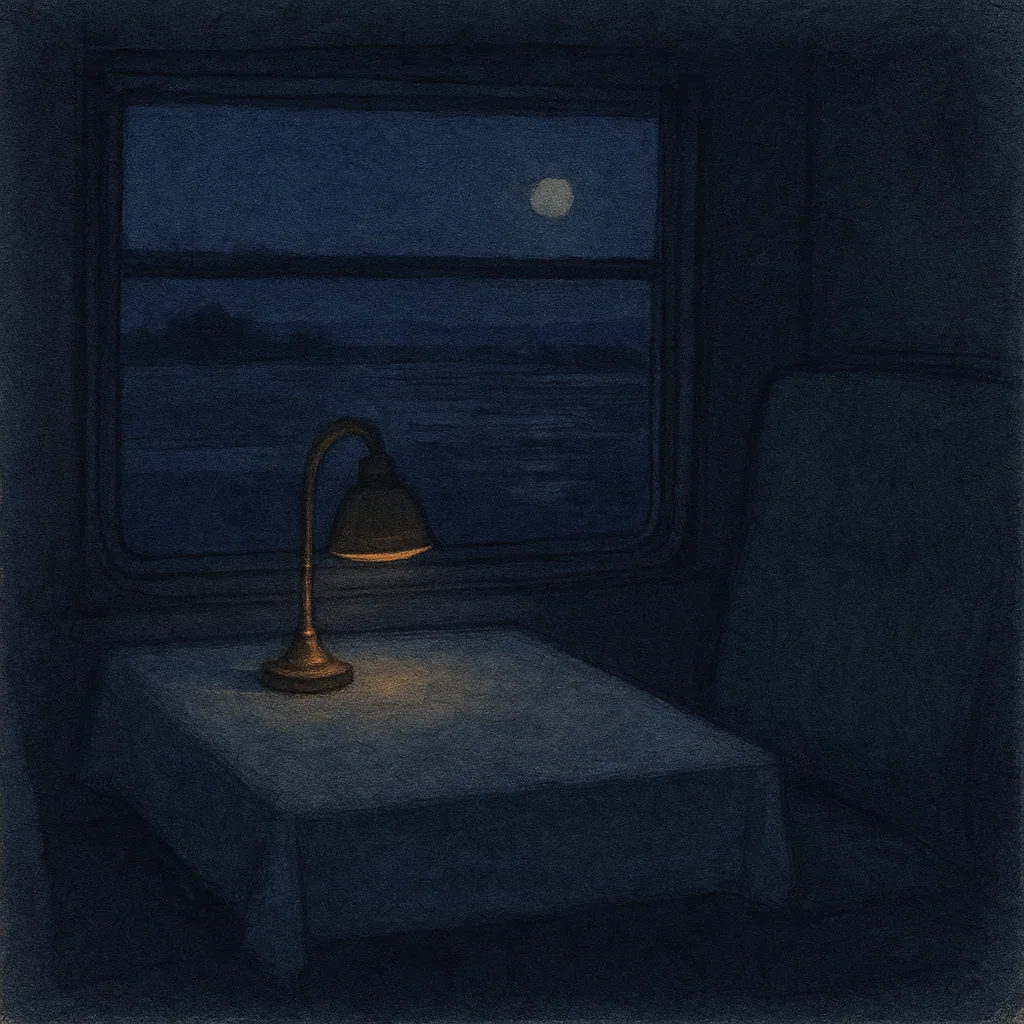
The brass collar of the reading lamp at your shoulder has gone smooth underneath, where fingers have turned it toward one page or another for longer than the varnish has lasted. You move it a few degrees downward and the light settles into a circle on the table. The cloth there is an older weave, thinned to threads at the corner nearest the window. The carriage takes a curve and the whole compartment leans, holds the lean, and comes back. Beyond the glass the dark is not complete. There are fields out there, black and level, and one farmhouse light standing in the middle of them. It travels along the window frame at the pace of a walk, then goes behind an embankment.
Inside, the lamplight reaches about as far as the opposite seat and stops. The panel between the windows is walnut veneer, laid in a fan, and the seams of the fan have lifted a little with the years of heat and cold. Above the seat there is a mirror with its silvering gone in freckles around the edges, so that the reflection of the lamp sits inside a scatter of small blooms. The luggage rack is woven cord on a brass frame, sagged in the middle in the shape of the cases that have rested there. On the wall below the rack, a framed photograph of mountains has faded to blue with a paler band down one side where the sun used to fall. The seat cushions are dark green moquette. Along the front edge of yours the nap is rubbed to a shine, and the shine runs the whole width, thinning where knees have passed.
The sound comes up through the floor first, then through the seat frame. The wheels cross the rail joints in sets of four, close together and then apart, close together and then apart, and the rhythm changes slightly when the train crosses a bridge and the noise goes hollow underneath. The pane beside you sits in a rubber lip that has hardened, so the glass ticks against it on the longer curves. Somewhere ahead a door in the corridor is drawn open and let go, and it rolls the last of the way and knocks into its jamb. Two carriages back, the guard is humming. It is eight or nine notes, then a pause, then the same notes again lower down, and the language they came from is not one you can place. He stops in the middle of a phrase and starts it later from the beginning.
You put your palm flat against the window. The cold comes through fast and stays, and when you lift your hand the shape of it holds on the glass for a moment before the edges go. The armrest between the seats is bare wood at the top, cool at first and then not, with a shallow dip worn into it about where a wrist would rest. Under the table your shoe finds the ribbed rubber of the floor, worn flat in a track from the door to the seat, the ribs still standing at the sides where nobody walks. The window catch is brass and stiff, and when you turn it the stiffness gives all at once and the sash drops an inch. Cold pours in across your knuckles, and you close it again, and the catch goes back with the same small resistance and the same giving way.
In that inch of open window the air carried the smell of turned soil, wet, and something else with it, a thread of woodsmoke from a chimney the train has already passed. The compartment has its own air, layered and settled. Dust warming on the hot glass of the lamp. Wool, old and clean. A faint oil smell that comes up through the floor with the sound. Someone earlier ate an orange in here and the peel of it is still in the ashtray under the window, dried to a curl the colour of tobacco. When the carriage rocks, the curl shifts a little against the metal and the smell of it rises again, thin, and thins away. Further off down the corridor there is tea in a glass somewhere, black and stewed, the sort left standing on a hotplate.
The train slows in a way you feel before you hear, the pull of it going out of the floor. A platform arrives alongside, two lamps and a concrete edge with grass through the cracks. There is no station building to speak of, only a shelter with a bench in it and a bicycle leaning on the shelter wall, its front wheel turned in. Nobody gets on. A handbell rings once from somewhere out of sight, flat and close, and then boots go over the gravel beside the track, unhurried, six or seven steps and a stop. Water is running into a metal container beyond the far platform, filling, the note of it climbing as it fills. A latch drops. The boots come back. The brakes let go with a long sigh underneath you, and the couplings take up their slack one after another down the length of the train, a row of small knocks travelling away toward the rear, and the platform edge begins to slide.
The moon is out on the other side of the train, low and half-covered, and it finds the water first. The fields here are ploughed and standing in shallow water between the furrows, so the ground goes past in long silver lines that bend when the ground bends. A row of poplars comes up and passes one by one, each one taking the moon behind it and giving it back. Then a dip full of mist, level as milk, with the tops of fence posts standing out of it. A farmhouse close to the line, shutters folded back, one upstairs window lit yellow and one dark, and a stack of split logs against the wall under the eaves with a sheet of tin weighted over the top. The train goes by and the yellow window slides along the length of your carriage and out. At a level crossing the gates are down and there is nothing behind them, only a white road going off between hedges, and the crossing lamp swings a little in its bracket as you pass.
You turn the lamp down to its lowest setting, and the compartment loses its far corners. The circle on the tablecloth shrinks to the size of a saucer. In the window now the reflection is stronger than the fields, so the lamp hangs out there in the dark, travelling along above the water and the furrows, doubled and faint. Your coat is folded on the seat beside you and you draw it across your knees. The wool holds the cold from the platform still, in the outer folds, and gives it up slowly. Two carriages back the humming starts again, further off than before, the same eight or nine notes, and the gap, and the notes lower. The rail joints come in their sets of four. The mist in the next field rises to the height of the window and the glass goes soft and grey, and somewhere in it there is a light, and the light stays for a long while at the edge of the frame without getting nearer or going, and the carriage leans, and comes back, and the fields go on turning over quietly under the water